In this video I explain how to capture an image from the screen using Clip2Net
In this video I explain how to capture an image from the screen using Clip2Net
I received this very good article from Faculty Focus that lists five things that faculty should include in their course materials and presentations to make sure they are not unknowingly committing plagiarism. Check it out.
<
Jing is a great tool for screencasting. You can capture anything on your screen and create an image or create a movie with your voice or your video included. Jing is easy to use and it it has a free and licenced version (that is not expensive). The movies you create cannot be longer than 5 minutes, though, but that makes it better when we are speaking of videos for instruction, doesn’t it?
Click on the image to see a brief tutorial on how to install and use Jing in your computer.
There are several ways of adding audio to a Powerpoint presentation, including using the same program to do it. However, files are usually too large even when they are saved as .flv. So here is another option that I have used and recommend. It is easy to install and simple to use.

Recording voice and uploading to a website or online course system may require certain steps, as you may have seen in my tutorials on how to use Audacity. Or it may be very simple if you just use a chat application that allows you to record a voice message and sends it back to your email as an mp3 file. You take that file, embed into your website or course, and that’s it…
This is what i tried with Google Talk and it worked really well, so I am going to share what I did:
1. I opened Google Talk and from my list of contacts I selected one and clicked on the arrow that shows me the option of sending a voice mail
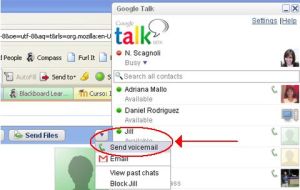
Select voicemail in G Talk
2. The message will start recording after a “Beep”. When you are done recording you click “End Call”
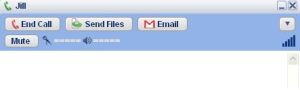
Record and end call
3. When you ended the call, your contact will receive the mp3 file in their gmail, in this format:

G talk mp3 file and console in email
You can send a voicemail to yourself so that you receive that file, or you can have the contact send the mp3 file back to you.
4. Download the mp3 file and you can use it directly in your course, blog or website, or you can also edit it with audacity.
This is an example:
Sample of MP3 recorded in G Talk
How can I use that in my online course site?
1. Create a welcome message for your students
2. Provide audio feedback for their assignments
3. Add audio to images, screenshots or powerpoints
4. Create podcasts with information, minilectures or comments to your class.
Vodpod videos no longer available. from www.screencast.com posted with vodpod
Vodpod videos no longer available. from www.screencast.com posted with vodpod
Feedback is key in a teaching and learning interaction. In fully online courses, it helps to keep alive the flow of communication between the members of the virtual community (Scagnoli & Willging, 2003), and it increases the sense of “presence” of the instructor or classmates in the interaction (Ice et.al, 2007) .
Feedback usually took the form of text or talk, in face to face interaction. Now, with the easy access to more sophisticated and less costly (free!) voice recording applications, audio feedback has become more popular in teaching. Either as MP3 files or in other formats, instructors record their voices and post them on the web, in the Course Management Systems, or in sites such as iTunes, My Podcasts, Del.icio.us, so that they can reach the students with their comments. Some instructors even invite students to do the same, and post comments or their assignments using audio. This task has become more easy to perform due to better access and more flexibility in producing, storing and re-producing audio files. Educational and Social podcasting is another phenomenon that is changing the way that students and faculty interact. (more…)
“I have everything in my favorites in my computer, I cannot remember those URL when I am using your computer”, my friend complained as we were developing a training seesion. Then I asked: “Have you tried del.icio.us, or furl?”. “What are you talking about, I am talking computers here”…”me, too” I explained.
“How would you feel about having all your bookmarks or favorite sites in an Internet bookmark, as a list of favorites that you find in any browser, in any machine connected to the Internet?” I asked…”That would be a future perfect!” my friend exclaimed. “Let me take you to that future” I said, and I “walked her through” the del.icio.us tutorials online. “I can’t wait to try this myself”, she said, and a couple of hours later my del.icio.us account was being hit several times by my friend and I was receiving new and very interesting links from her, who, (of course) is in my network.
So what is so special about del.icio.us or other social bookmarking sites? (more…)
 More about Web 2.0 Cool Tools

 eLearning Tutorials
